The Japanese yen is hovering near its weakest point in approximately four decades.
At the time of publication, the currency was trading at roughly ¥162 to the U.S. dollar, a level that again raised the possibility of intervention by Japanese financial authorities. For Japanese companies selling products internationally, the exchange rate creates what initially appears to be a straightforward opportunity: earn revenue in strong U.S. dollars while many operating and production costs remain denominated in weaker yen.
But the real calculation is more complicated.
A weak yen can make Japanese exports more competitive in the American market and increase the yen value of every dollar earned. At the same time, it makes nearly every American expense more costly for a company funding its expansion from Japan.
Retail construction, commercial rent, trade show exhibits, event production, local labor, freight, storage, and marketing are all typically priced in dollars. A $100,000 American project would have represented approximately ¥11 million when the exchange rate was ¥110 to the dollar. At ¥162, that same project represents more than ¥16 million.
The strategic question is therefore not simply whether the weak yen is good or bad for Japanese businesses. It is whether Japanese brands can turn a temporary currency advantage into a lasting position in the American market.
A favorable exchange rate is not the same as a market strategy
A Japanese company exporting products to the United States generally has two ways to respond to a weaker yen. It can reduce its dollar price and use the currency advantage to compete more aggressively, or it can maintain American pricing and generate higher revenue when those dollars are converted back into yen.
The right decision depends on the brand. A new consumer product may use part of the exchange-rate advantage to lower the barrier to trial, support retailers, or invest in marketing. A premium brand may preserve its pricing and reinvest the additional value into stores, events, and customer acquisition.
Onitsuka Tiger offers a timely illustration. The Japanese footwear brand is preparing for a new phase of global expansion, including a Los Angeles flagship planned for early 2027. Reuters reported that its sales grew by approximately one-third during the first quarter of 2026 while operating margin reached roughly 40%. The brand has also benefited from international consumers traveling to Japan and purchasing products at prices made more attractive by the weak yen.
The opportunity is significant, but so is the risk. Flagship stores, international operations, and new corporate infrastructure introduce substantial costs. Analysts have warned that rapid expansion could place pressure on the margins that made the strategy attractive in the first place. The currency may create an opening, but poor execution can consume the advantage quickly.
The most valuable outcome is not cheaper exports. It is dollar revenue.
The strongest long-term strategy is to move beyond treating the United States exclusively as an export destination. A company that depends on regular transfers from Japan to pay American expenses remains exposed to the exchange rate. Every lease payment, exhibit, installation, and advertising campaign becomes more expensive when measured in yen.
A company generating meaningful American revenue can begin paying those expenses with dollars earned in the same market. Dollar revenue can fund local marketing, trade shows, retail installations, storage, repairs, employee compensation, and future expansion. This creates a natural alignment between revenue and expenses, reducing the need to repeatedly convert weaker yen into more expensive dollars.
The immediate goal may be to increase exports. The more important goal is to build an American operation that can eventually support itself. That requires treating trade shows, retail environments, and experiential campaigns not as isolated promotional expenses, but as infrastructure for customer acquisition and market development.
“The exchange rate may create the opening. What a company builds through that opening will determine whether the opportunity lasts.”
Japanese brands should test the market without looking temporary
The American market is too large and too varied to approach with a single national assumption. A product that performs well in Los Angeles may reach a different audience in New York, Dallas, Chicago, or Salt Lake City. A brand that attracts attention at a consumer event may discover that its strongest opportunity lies in specialty retail, professional distribution, hospitality, architecture, or another business-to-business channel.
The logical response is to test the market before committing to a large permanent rollout. That does not mean arriving with an improvised display or a generic booth. A temporary environment still communicates the brand’s quality, ambition, and level of commitment.
The challenge is to create a physical presence that feels permanent while remaining adaptable. A well-designed system can begin as a trade show exhibit, appear later as a product-launch environment, and then be adapted into a pop-up, press preview, dealer showroom, or shop-in-shop. Components can be resized, reconfigured, refinished, and redeployed as the company learns where its strongest American opportunities exist.
This is particularly important during a period of currency volatility. Instead of funding a completely new environment for every appearance, the brand invests once in a family of reusable assets. The result is not simply a lower fabrication cost. It is a more disciplined method of entering the market.
Protecting Japanese brand integrity requires more than translating the graphics
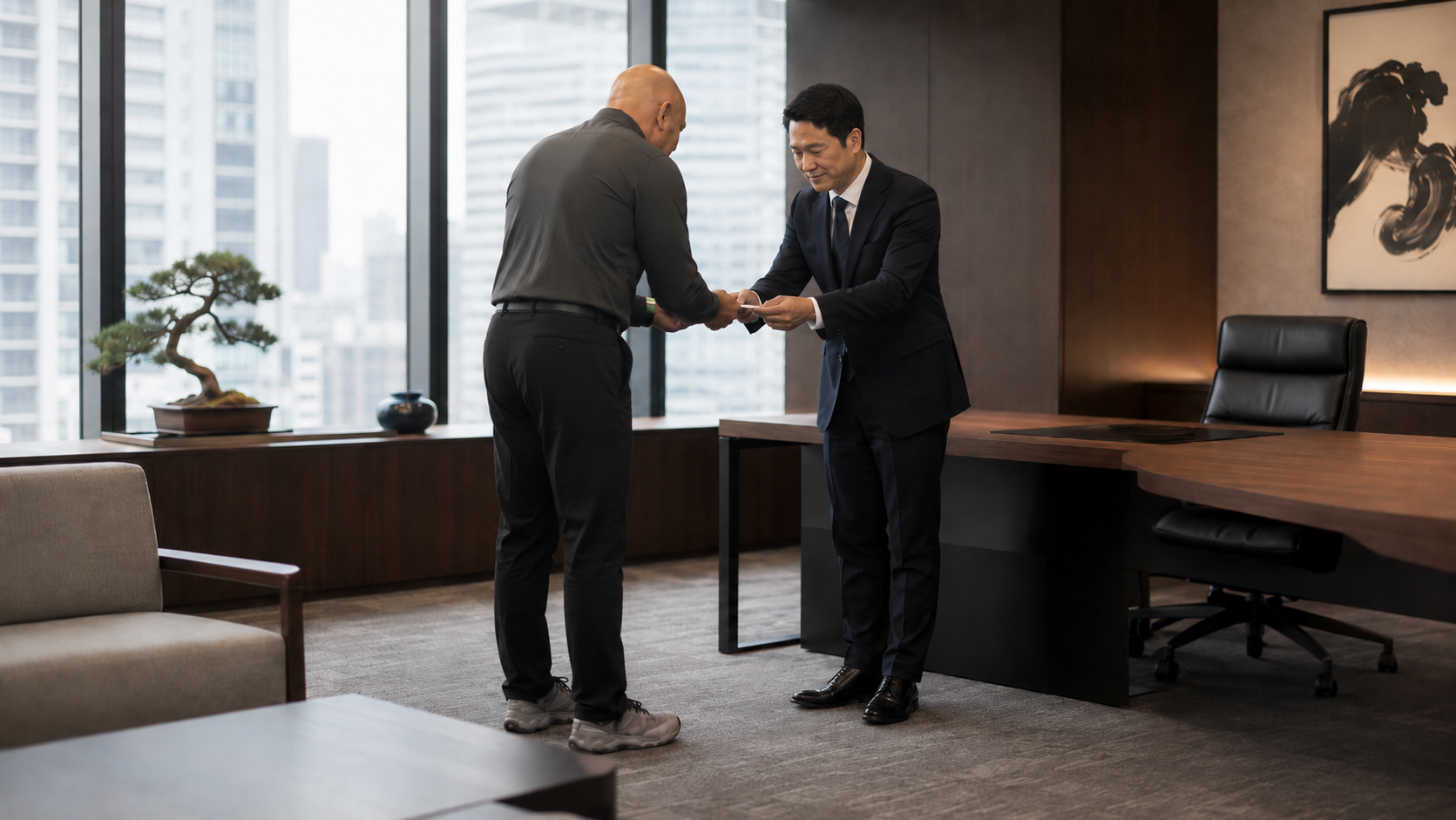
Japanese brands are frequently associated with precision, restraint, craftsmanship, and close attention to detail. Those qualities can be diluted when a concept moves from a Japanese headquarters team to an unfamiliar production environment thousands of miles away.
The problem is rarely the original creative direction. It is what happens during execution. Materials available in Japan may not be practical or economical in the United States. Dimensions, electrical systems, building regulations, and fire requirements differ. Convention venues impose their own rules. Some cities and facilities require union labor. Freight distances are considerably longer, and a structure that works beautifully in a permanent Tokyo environment may not be engineered to survive repeated shipping across the United States.
Literal reproduction is not always possible. Careless adaptation, however, can make a carefully controlled brand look generic. The role of an American partner should not be to reinterpret the Japanese company’s identity. It should be to protect that identity while adapting the physical execution to local conditions.
That might involve identifying American materials that preserve the intended appearance, engineering components for repeated assembly, converting a flagship concept into smaller footprints, or creating modular structures without allowing the result to feel modular. The most successful adaptation is often invisible to the customer.
Local fabrication can reduce more than shipping costs
It may appear logical to manufacture an entire branded environment in Japan and ship it to the United States. In some cases, distinctive finishes, specialty products, or signature elements should be produced in Japan. Shipping the complete structure, however, introduces international freight, customs processing, duties, long lead times, and difficult repair requirements.
A hybrid approach is often more resilient. Japanese headquarters can retain control over the architecture, brand standards, and critical visual elements, while an American partner handles local engineering, material sourcing, fabrication, installation, storage, and redeployment.
Walls, counters, platforms, shipping crates, and structural components can often be manufactured near the market where they will be used. Distinctive products and finishes can still be imported when their authenticity or quality cannot be replicated locally. This is not a compromise between Japanese quality and American convenience. When managed correctly, it preserves what makes the brand distinctive while eliminating unnecessary logistical exposure.
The shipping crate is part of the design
One of the most frequently overlooked parts of a trade show or experiential program is what happens after the environment has been designed. A beautiful exhibit must still be built, transported, installed, dismantled, packed, stored, and used again.
Every wall, shelf, counter, lighting component, graphic, and finished surface needs a secure location inside a shipping crate. The crate must protect the components from one another, distribute weight properly, allow an installation crew to locate parts quickly, and provide a logical sequence for repacking after the event.
A structure designed only around its appearance may require too many crates, create unnecessary freight expenses, or suffer damage every time it is moved. For a Japanese company paying American logistics expenses with yen, reducing volume, eliminating unnecessary weight, and planning efficient reuse can lower costs over the entire life of the program.
Reusable assets can turn one investment into several market tests
A launch in the United States rarely consists of a single event. The same brand may need to support a press preview, an industry trade show, an influencer event, a department-store activation, a temporary retail location, and the opening of a permanent showroom.
Those programs are often assigned separate budgets and developed as unrelated projects. A more efficient strategy begins by identifying what can be shared. A branded product wall created for a trade show may later become part of a pop-up. A reception counter can be refinished or reconfigured. Display fixtures can move into a dealer showroom. Lighting, digital screens, and graphic structures can be used across several campaigns.
Not every component should be reused forever. Some environments require a unique moment. But designing for adaptability from the beginning allows the company to reserve more of its budget for the customer experience rather than repeatedly purchasing the same basic infrastructure. This is how a temporary currency advantage can begin creating permanent brand assets.
The weak yen is also a warning against waiting indefinitely
Currency conditions can change quickly. A strategy built entirely around an exchange rate is not a strategy that can be trusted. Japanese authorities have already faced pressure to respond to the yen’s decline, and the currency remains sensitive to interest rates, energy prices, geopolitical instability, and expectations of government intervention.
The weak yen also creates problems inside Japan. It raises the local cost of imported energy, raw materials, and other inputs. Recent Japanese wholesale-price data showed how higher fuel costs and currency weakness can increase the cost of production even when export revenue becomes more valuable.
Japanese brands should avoid assuming that current conditions will continue indefinitely. The window is not an invitation to expand recklessly. It is an opportunity to establish American demand, build local relationships, and begin generating dollar revenue while the export environment remains favorable.
Turning a temporary advantage into a permanent presence
The weak yen can help Japanese products reach American consumers more competitively. It can increase the value of dollar sales and provide additional resources for international growth. It cannot select the right market, protect a brand during fabrication, manage an installation, control logistics, or create customer loyalty.
Those outcomes depend on execution. For Japanese brands considering the United States, the objective should not be to spend as little as possible on a temporary market test. It should be to create a disciplined physical platform that can begin small, adapt to what the market reveals, and grow with the company.
That platform may start with a trade show, a product launch, or a temporary retail installation. Over time, it can develop into a network of showrooms, dealer environments, recurring events, and permanent locations. The exchange rate may create the opening. What the company builds through that opening will determine whether the opportunity lasts.
Planning a U.S. retail, trade show, or experiential program?
Ethos Edge Creative helps international brands translate established creative direction into physical environments designed for the American market. Our capabilities include design adaptation, technical development, fabrication, installation, logistics, storage, and long-term asset management.
Discuss a U.S. Project With Ethos Edge CreativeSources and further reading
Reuters on the yen level and intervention context · Reuters on Onitsuka Tiger growth and U.S. expansion · Reuters on Japanese wholesale prices and weak-yen pressure.
This article is provided for general business information and does not constitute financial or investment advice.